Lisa Casella Steps into Senior Associate Role
DW Fox Tucker Lawyers is pleased to announce Lisa Casella’s progression to Senior Associate in our Workplace team. Lisa brings more than a decade of experience in employment and industrial relations…
Key Legal Risks Every Real Estate Agent Should Be Aware Of
At DW Fox Tucker Lawyers, we work closely with South Australia’s real estate sector and understand the challenges agents face at every stage of their careers, including those just starting. Real…
When is Consent Required to Record a Conversation?
You have probably heard a statement at the start of a telephone call, or this could be in a Teams or a Zoom meeting, along the lines of “Before we continue, I’d like to let you know that this call…
Growth and Internal Promotions at DW Fox Tucker Lawyers
DW Fox Tucker Lawyers is pleased to announce the appointment of James Geddes as Senior Associate in the firm’s Litigation Team, together with the internal promotions of Sally Monaghan and Rachael…
AI Evidence in Australian Commercial Litigation (2026): Courts, Risks and Litigation Strategy
Australian courts are no longer silent on how AI evidence should be treated in commercial litigation. Between January 2025 and mid-2026, the Supreme Court of New South Wales, the Federal Court of…
Celebrating Our Inclusion in the 2027 Edition of Best Law Firms™ - Australia
The 2027 edition of Best Law Firms™ - Australia has been announced today, and DW Fox Tucker Lawyers is thrilled to once again be recognised in 12 categories. Best Law Firms™ - Australia, established…
When Forecasts Go Wrong: United Petroleum’s Win Against Perth Airport Over the Qantas Relocation Promise
The Federal Court has entered judgment for United Petroleum Pty Ltd (United) against Perth Airport Pty Ltd (PAPL) in United Petroleum Pty Ltd v Perth Airport Pty Ltd (No 2) [2026] FCA 620 over…
Commercial Litigation in an Evolving Regulatory Landscape
As the legal landscape continues to evolve, recent developments have emerged as pivotal influences on commercial litigation practices within Australia. A particularly noteworthy change is the…
ACCC Investigations in Australia 2026: a Practical Playbook for Businesses
An ACCC investigation in Australia can arrive without warning, a phone call from the regulator, a section 155 notice demanding documents, or a dawn raid, and the decisions made in the first hours…
Livable Housing Design Standard changes postponed in South Australia
Previous history The National Construction Code (NCC) 2022 replaced the NCC 2019 in South Australia effective 1 October 2024, and mandates the ABCB Silver Level Standard for Livable Housing Design,…
Explore Articles:
- View All News
-
Areas of Practice
- Compulsory Acquisition
- Conveyancing
- Corporate & Commercial
- Construction & Engineering
- Dispute Resolution, Commercial Litigation & Insolvency
- Employment, Workplace Relations & Safety
- Energy & Resources
- Family Law
- Insurance & Risk Management
- Intellectual Property (IP)
- Property
- Strata & Community Titles
- Tax
- Wills & Estate Planning
- Workers Compensation & Self Insurance
-
Industry Specialisation
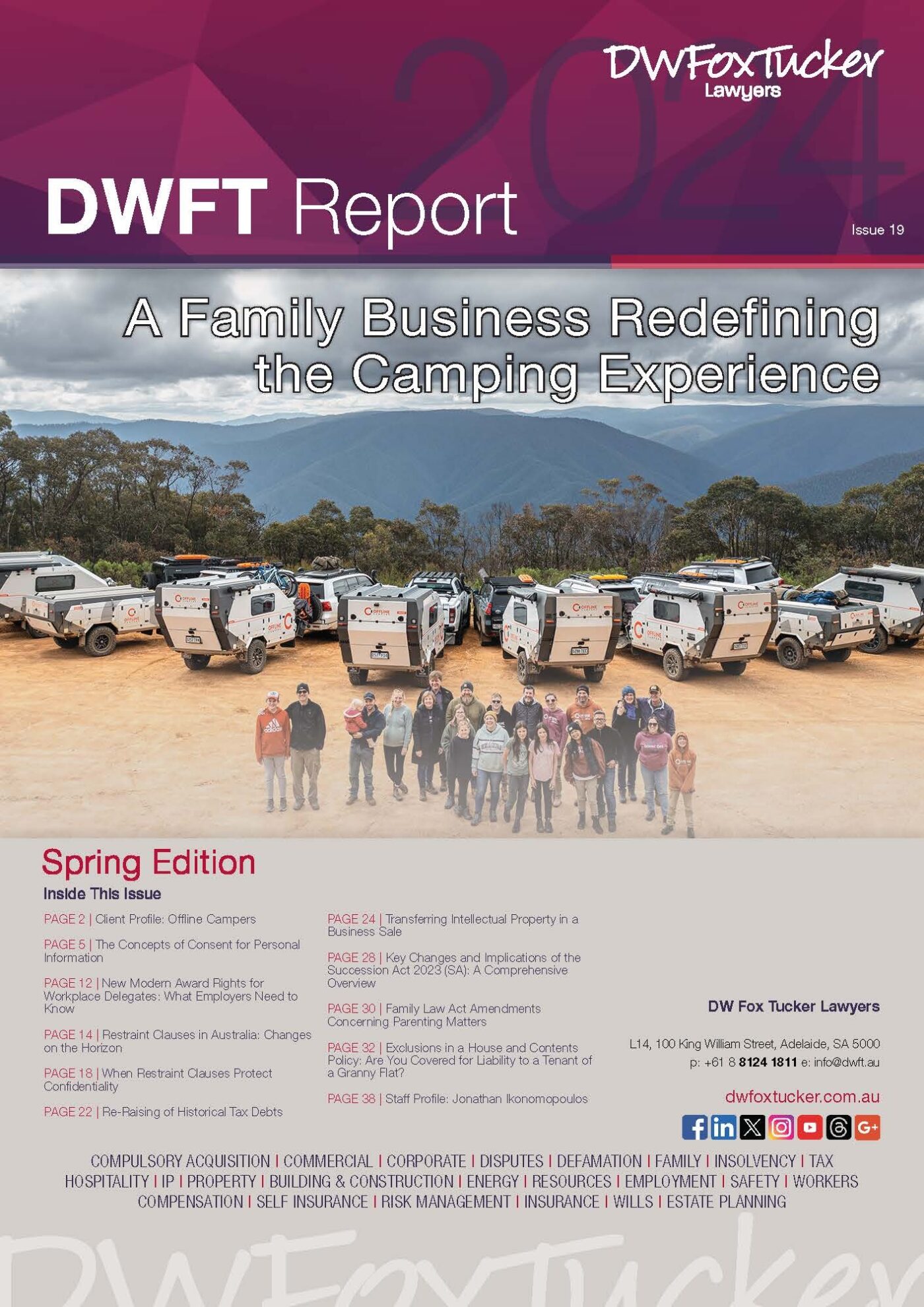
DWFT Report
The DWFT Report is a comprehensive publication containing news, commentary and analysis of significant contemporary legal issues impacting the Australian business community.